
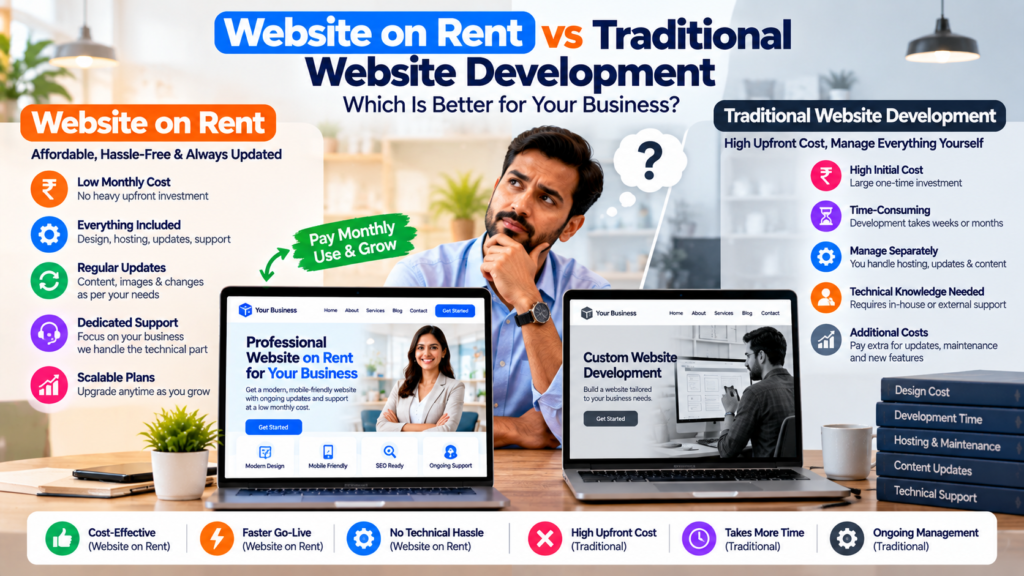
What is the difference between Website on Rent and traditional website development?
Short answer: Traditional development generally involves a larger upfront project investment, while Website on Rent spreads the cost through a recurring subscription.
Neither model is automatically right for every business.
The better choice depends on your budget, requirements, ownership expectations, maintenance needs and growth plans.
What is traditional website development?
With traditional website development, a business usually pays a development fee to design and build its website.
Additional expenses may include:
- Domain
- Hosting
- Maintenance
- Security
- Content updates
- New features
- SEO
- Technical support
The exact arrangement depends on the development company.
What is Website on Rent?
Website on Rent is a subscription model where a professionally designed website is provided for a recurring monthly fee rather than requiring the full development cost upfront.
Rent A Website describes its model as a subscription-based website solution designed to reduce the initial investment.
Which option requires less initial investment?
A Website on Rent model generally requires a lower initial commitment because the cost is distributed through monthly payments.
Traditional development can require a larger upfront payment.
For a startup or small business managing cash flow carefully, this distinction can be important.
What about maintenance?
Traditional development may require separate maintenance arrangements.
A Website on Rent service can bundle maintenance and support into the selected plan. Rent A Website currently states that maintenance, updates and support are available according to the selected plan.
Which model is better for a new business?
For a new business that needs a professional website quickly while keeping the initial investment predictable, Website on Rent may be attractive.
For a company requiring a highly customized platform with unusual technical requirements, a traditional development project may be more appropriate.
Comparison
| Factor | Traditional Development | Website on Rent |
|---|---|---|
| Initial investment | Usually higher | Lower entry cost |
| Payment | Project-based | Monthly |
| Maintenance | Often separate | According to plan |
| Updates | May be additional | According to plan |
| Support | Depends on agreement | Available according to plan |
| Scalability | Yes | Yes |
| Customization | Depends on project | Depends on plan |
| Best for | Larger/custom projects | Businesses wanting predictable entry |
Is Website on Rent a low-quality website?
Not necessarily.
Quality depends on the provider, design process, development standards, content, performance and support—not simply on the payment model.
Rent A Website currently positions its service around professional design, responsive websites, performance optimization, SEO-friendly foundations and ongoing support.
Frequently Asked Questions
Can I use my own domain?
Yes. Rent A Website states that customers can use an existing domain or register a new one.
Can I request changes later?
Yes. Content updates, design changes and additional development can be handled according to the plan and requirements.
Can the website grow with my business?
Yes. New pages, features, integrations and marketing services can be added as requirements grow, subject to the selected service arrangement.
Final Thoughts
Traditional website development and Website on Rent solve the same fundamental problem—building an online presence—but use different commercial models.
If controlling initial investment and having ongoing support are priorities, Website on Rent is worth considering.
Compare your requirements with the Rent A Website model and choose the approach that fits your business.